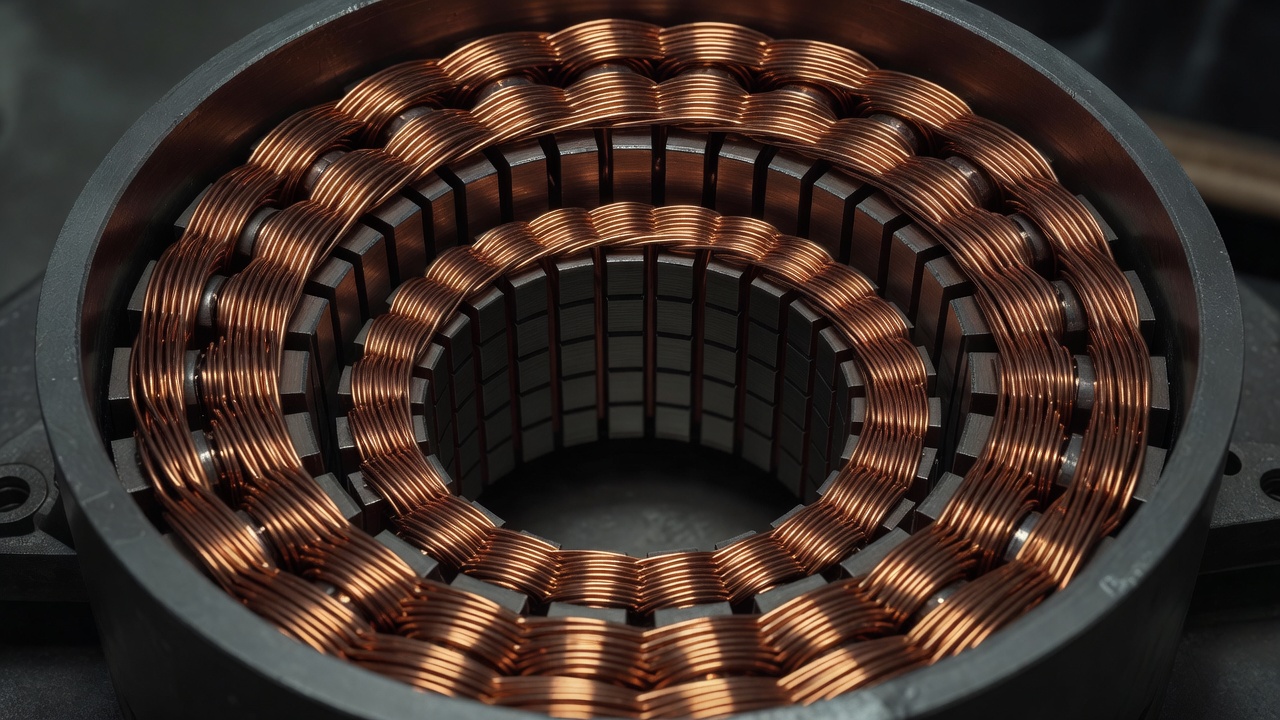
The Demand for High Torque Density
In lightweight vehicle engineering, the propulsion system cannot simply be upscaled to achieve higher performance. Bolting a massive, heavy motor into a carefully optimized carbon-fiber chassis undoes the painstaking work of weight reduction. Therefore, the priority shifts from sheer peak power output to optimizing torque density—producing the maximum rotational force from the smallest, lightest possible package.
Electric motors are fundamentally highly efficient, frequently converting over 90% of electrical energy into mechanical energy. However, pushing beyond standard efficiencies into the high 90s requires rigorous optimization of magnetic flux, thermal management, and inverter switching speeds. The topology of the motor plays a deciding role in a vehicle's overall packaging and mass distribution.
Radial Flux vs. Axial Flux Topologies
The vast majority of mass-market EVs rely on Radial Flux motors. In a radial flux design, the magnetic field operates perpendicular to the axis of rotation—expanding outward from the central rotor to the surrounding stator. These motors are well-understood, cost-effective to manufacture in high volumes, and highly reliable. They tend to form a long, cylindrical shape, which fits reasonably well into standard axle configurations.
However, for specialized lightweight and high-performance applications, the industry is increasingly turning to Axial Flux motors. In this topology, the magnetic field operates parallel to the axis of rotation. The stator and rotor are arranged as discs stacked alongside one another, rather than one inside the other.
- Form Factor: Axial flux motors resemble a large, thin pancake. This highly compact shape allows them to be packaged in tight spaces, such as inside wheel hubs or sandwiched directly between a battery pack and a transmission, drastically reducing overall drivetrain volume.
- Weight and Density: Due to their geometry, axial flux motors utilize copper windings and magnetic materials more efficiently. They typically offer a significantly higher power-to-weight ratio compared to radial counterparts, making them ideal for strict lightweighting targets.
- Cooling Challenges: The primary drawback to axial flux designs is thermal management. The compact, stacked nature of the components makes it difficult to route cooling channels through the motor effectively. High sustained outputs require advanced liquid cooling solutions to prevent magnet demagnetization.
Silicon Carbide (SiC) Inverters
The motor itself is only one half of the propulsion equation; it relies entirely on the inverter to convert direct current (DC) from the battery into the alternating current (AC) it needs to spin. The efficiency of this conversion dictates how much raw power reaches the wheels and how much is lost as waste heat.
Historically, inverters utilized insulated-gate bipolar transistors (IGBTs) based on standard silicon. In the pursuit of efficiency, modern lightweight EV platforms are migrating to Silicon Carbide (SiC) MOSFETs. SiC semiconductors can operate at significantly higher switching frequencies, higher temperatures, and higher voltages. This translates to fewer switching losses and allows for the entire inverter unit to be downsized. A smaller, more efficient inverter requires less aggressive cooling hardware, compounding the weight savings across the vehicle.
Integration and the "e-Axle"
To further reduce mass, manufacturers are consolidating drivetrain components. Rather than housing the motor, inverter, and reduction gearbox in separate enclosures linked by heavy high-voltage cables, modern engineering combines all three into a single, compact housing known as an e-Axle.
This deep integration eliminates the weight of redundant aluminum casings, fluid lines, and mounting brackets. By housing the inverter directly adjacent to the motor stator, power delivery becomes near-instantaneous and highly efficient. For lightweight EV platforms, the fully integrated e-Axle represents the ultimate expression of mechanical and electrical packaging, delivering necessary torque while respecting the strict mass constraints of the chassis.